The Trillion-Dollar Opportunity: Turning the Tide on Maternal and Child Health
Investing in the health of women and children is both a moral imperative and a massive economic catalyst. Recent research shows that closing the women’s health gap could add $1 trillion into the global economy annually by 2040, yielding a $3 return in economic growth for every $1 invested. The impact stretches across generations because protecting a mother’s health today secures the workforce and communities of tomorrow. For the safety and wellbeing of women and children, a range of products to manage health conditions and prevent avoidable deaths already exists, but these solutions need to be scaled up across low and middle-income countries (LMICs).
Figure 01: The scale of the opportunity to improve the health of women and children in LMICs.
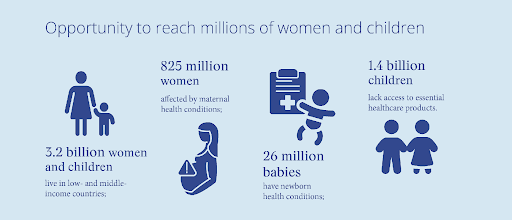
Source: Access to Medicine Foundation modelling based on 2023 IHME Global Burden of Disease DALY data.
Among the greatest health challenges facing women and children today, infectious diseases especially sepsis remain one of the heaviest burdens on families. Sepsis alone claims 3.4 million children annually, with 85% of those deaths occurring before age five. For women, maternal sepsis accounts for approximately 11% of maternal deaths globally. Even in countries like the United States, 1 in 3 people who die in a hospital had sepsis during their stay.
We already have the blueprints to know how to fix this when the world pays attention. Back in 2009, malaria claimed approximately 850,000 lives annually, of which most were children under five in sub- Saharan Africa. When the pharmaceutical industry turned its focus to child-friendly formulations of the antimalarial, Coartem® Dispersible and Coartem Baby, this was a game changer. By reaching more than 500 million treatments for children, this innovation saved an estimated 1.8 million lives.
Yet, critical gaps remain. As we wait for the broader pharmaceutical industry to mature its approach to these populations, our latest report on access to antibiotics and antifungals show a mixed bag when measuring antibiotic investments and actions. At the moment, only 13% of projects in development are designed for children under five. While the research and development remains at stake, there is promising momentum that could directly benefit women and children. Several companies are already developing paediatric versions of antibiotics alongside adult formulations which has the potential to offer a treatment option for children who are currently left without. We are also seeing breakthroughs in treatments for drug- resistant gonorrhoea and urinary tract infections (UTIs) – infections that disproportionately disrupt maternal and neonatal outcomes. New candidates zoliflodacin and gepotidacin represent the first new oral antibiotic classes for these conditions in decades. However, the pipeline is not enough, and these promising candidates must now be rolled out rapidly within countries to actually reach the front lines and save lines.
New procurement ideas like the “Netflix subscription-style” payment models in the United Kingdom and Sweden’s Strategy to Curb Antimicrobial Resistance 2026-2035 can help. Initiatives like SECURE are expanding access to antibiotics specifically for neonatal and maternal sepsis. However, for these models to be truly successful, they must be designed to explicitly prioritise the unique needs of sepsis and paediatric products.
The untapped opportunity
Beyond infectious diseases, one of the greatest opportunities to reduce maternal mortality lies in preventing and managing complications during pregnancy and childbirth. Maternal hypertensive disorders, which account for 16% of maternal deaths globally, and postpartum haemorrhage can both be effectively prevented or managed. Yet inequitable access to essential health products and persistent supply chain bottlenecks continue to limit the reach of these life-saving interventions.
In high-burden regions, essential medicines for maternal health are twice as likely to face chronic stockouts compared to those with broader clinical uses due to fragmented supply chains. Resolving this bottleneck is a substantial economic lever. Closing the maternal hypertension gap alone could add an estimated $1.4 billion to global GDP annually.
When we get it right, the results are historic. Prioritising universal access to ground-breaking oxytocin revolutionised the prevention of postpartum haemorrhage, with an estimated forecast of 1.4 million lives saved over a 10-year period since 2018. Theseare market successes that reached millions of waiting patients.
Innovation only matters if it reaches those who need it most
The real opportunity lies in bridging the gap between innovation and delivery. We are already seeing how de-risking tools have enabled access to quality-assured diagnostics and treatments for preeclampsia and maternal anaemia in countries like Ghana, Kenya, Malawi, Senegal, and Tanzania. Similarly, volume guarantees have enabled access to medical oxygen and vital diagnostics in countries like Kenya and Tanzania, reaching a scale that has the potential to save over 150,000 lives. Interventions like these bring vital care directly to the front lines and build systemic resilience.
With the 2030 Sustainable Development Goals approaching, the cost of delay is measured in lives we have the power to save.
The pharmaceutical industry has the manufacturing power, but their development partners hold the actual blueprints. These partners create guidelines, build action plans and unlock the funding needed to get medicine to the patients. Real progress depends on accountability and the sharing of best practices, which is exactly where our strategy focuses. Building delivery systems and raising awareness efforts are futile if the physical tools to diagnose and treat these diseases are missing on the ground.
The progress of the last decade shows what is possible when governments, investors, and industry stop treating low- and middle-income countries as secondary markets and start recognising them as primary drivers of global growth. Ultimately, healthcare’s litmus test is whether women and children get access to life-saving care regardless of where they live.
Author:

Dr. Jayasree K Iyer
CEO , Access to Medicine Foundation , Amsterdam, The Netherlands
Publication Date: 2nd July 2026