
Background
India has made notable progress in improving maternal and child health (MCH) outcomes over the past decade through expanded antenatal care (ANC) coverage, institutional deliveries, strengthened public health programmes and increased availability of essential maternal and newborn health services. While coverage of key maternal health services has improved, coverage alone does not necessarily translate into effective care.
Critical gaps remain in early detection of high-risk pregnancies, timely diagnosis of maternal conditions (for e.g. Anaemia, Pre-eclampsia, Hypothyroidism), foetal monitoring, maternal infections, referral pathways and quality of service delivery – particularly in low resource, underserved settings. Many adverse maternal and neonatal outcomes continue to be driven by delayed diagnosis, fragmented care journeys, inadequate longitudinal monitoring and delayed clinical decisions.
To address these gaps, India Health Fund (IHF) aims to identify innovations that would strengthen the quality and coverage of antenatal care through evidence-based service delivery. We are looking for mid-to-late stage and market-ready point-of-care (PoC) diagnostics and digital health solutions across the antenatal care continuum. IHF also aims to build a cohesive, evidence-driven platform that can accelerate the integration of promising innovations into the public health system by providing capacity building and systemic support.
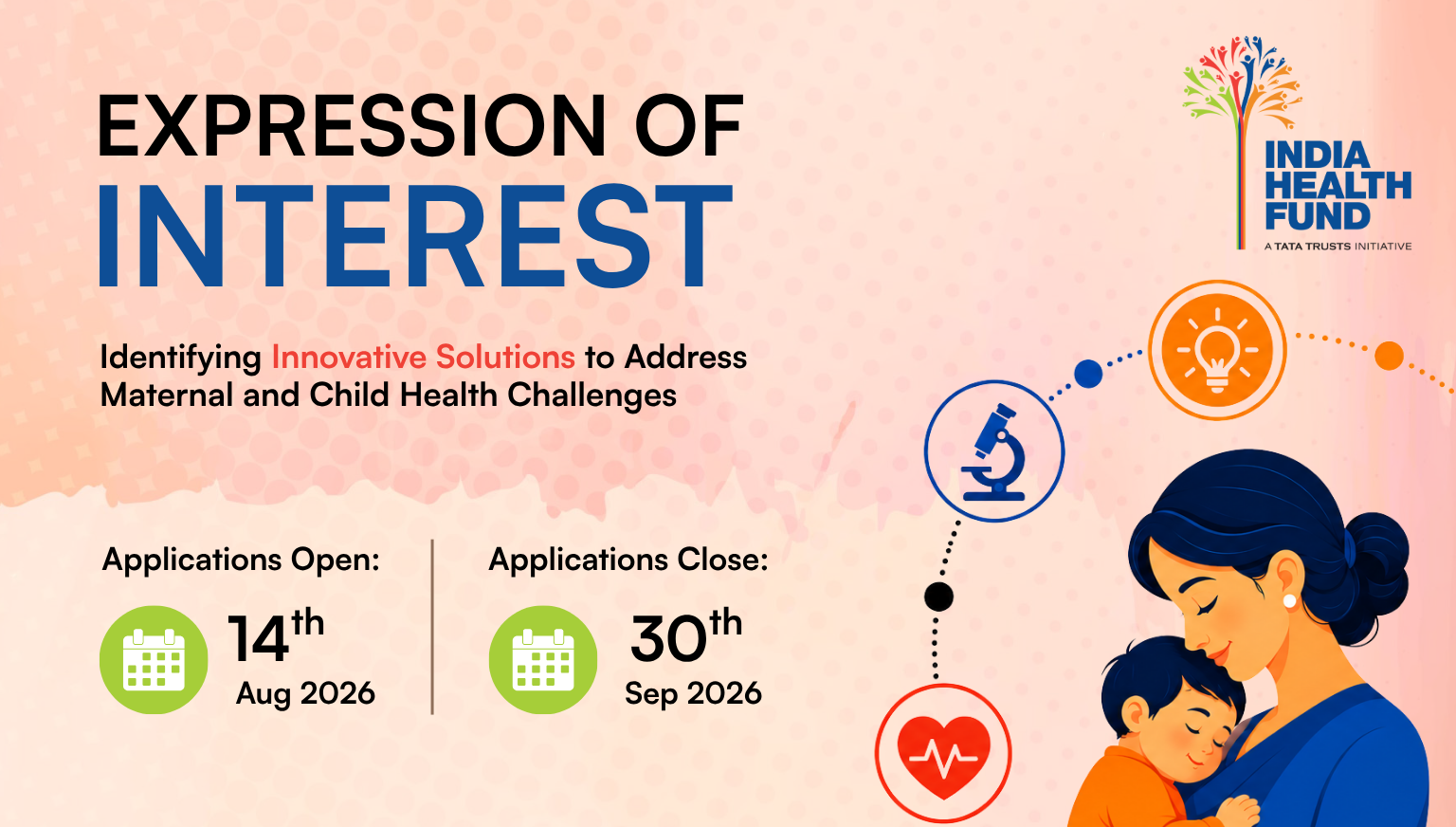
In that context, India Health Fund is launching an Expression of Interest (EoI) to identify and engage with innovators developing impactful solutions that address critical unmet needs.
PURPOSE OF THIS EoI
This EoI is intended to support innovation scouting and pipeline development for promising maternal and child health solutions with the potential to improve health outcomes in India; with a focus on low-resource settings. Through this EoI, we seek to identify Indian innovations that can address high-priority MCH challenges across diagnostics, digital health, clinical decision support, workflow optimization, and health systems strengthening.
This EoI is therefore not a direct funding call but an opportunity to build a pipeline of high-potential innovations for future Call for Proposals. Selected innovations may be considered for future engagement opportunities, including but not limited to:
- Technical validation and evidence generation support
- Product refinement and implementation support
- Pilot and deployment opportunities
- Potential future funding support (subject to subsequent evaluation and program priorities)
Support provided to selected innovations following the call for proposal:
- Thematic & Technical Expertise: Provides access to IHF personnel and domain experts within maternal health. This support helps innovators refine product usability, strengthen problem-solution fit and align solutions with clinical and health system needs.
- Validation & Evidence Generation: Supports innovators in designing and providing feedback on technical, clinical and field validation exercises aligned with relevant clinical standards and evidence requirements in India; helping demonstrate safety, effectiveness and real-world utility.
- Scale-Up Readiness: Supports innovators in strengthening readiness for manufacturing, commercialization and scale-up; including guidance on market access, partnerships and adoption pathways.
- Implementation & Adaptive Learning: Provide support during pilot and deployment phases, to identify and solve for operational bottlenecks, improve adoption and enable adaptive learning for iterative solution improvement.
Priority Innovation Areas
We invite expressions of interest from innovators developing solutions across the following priority areas.
Priority Area 1: Anaemia and its Causes
Timely diagnosis and appropriate management of maternal conditions such as anaemia, iron deficiency, haemoglobinopathies and hypothyroidism remain constrained by limited access to quality diagnostics at the point of need. Current diagnostic pathways often rely on centralized laboratory infrastructure, multiple patient visits, sample transportation and delayed turnaround times – leading to missed opportunities for early intervention and continuity of care during pregnancy.
While routine antenatal screening identifies many women at risk, important diagnostic gaps remain. Haemoglobin estimation alone may not adequately differentiate the underlying causes of anaemia, or those related to it. Advanced tests such as serum ferritin, hypothyroidism etc. are often inaccessible at primary care; screening for haemoglobinopathies remains dependent on specialized laboratory methods and timely thyroid screening during the first trimester is not consistently achieved. These challenges are further compounded by logistical barriers related to sample collection, storage, transportation and follow-up.
We are seeking innovations that strengthen the diagnostic capacities for quality ANC at primary and secondary healthcare levels, specifically for conditions like anaemia, serum ferritin, hypothyroidism and hemoglobinopathies. In turn enabling earlier, more accurate and clinically actionable decision-making.
Illustrative innovation opportunities include:
- Comprehensive 1st trimester maternal screening solutions that integrate TSH, assessment alongside routine antenatal blood tests (CBC, HBsAg etc.)
- Affordable point of care diagnostics that improve identification and differentiation of anaemia, including technologies supporting reflex testing for iron deficiency where clinically indicated.
- Low cost, portable diagnostic solutions or simplified diagnostic pathways for haemoglobinopathies that provide performance comparable to reference laboratory methods (e.g. HPLC).
- Novel sample collection, stabilization, storage and transportation technologies that preserve sample integrity while reducing dependence on cold-chain logistics and centralized laboratories.
- Integrated diagnostic and digital solutions that support longitudinal monitoring, treatment decisions and referral pathways across the ANC continuum.
Priority Area 2: Digital Health Solutions for Pregnancy Monitoring
Despite improvements in ANC coverage, the quality and continuity of pregnancy monitoring remain suboptimal. Current ANC workflows rely heavily on episodic assessments, manual documentation and fragmented records – limiting longitudinal monitoring and timely identification of high-risk pregnancies. Frontline health workers often operate under high workloads with limited decision-support, while pregnant women may discontinue care due to socio-economic factors or poor continuity across facilities.
We are seeking digital health solutions that strengthen pregnancy monitoring, improve clinical decision making and enable continuity of care throughout the antenatal journey. Solutions should support frontline healthcare workers in delivering high-quality ANC, facilitate timely identification and management of high-risk pregnancies and enable women centred care through improved access to information and continuity across different levels of the health system.
Illustrative innovation opportunities include:
- Digital platforms that guide frontline workers through comprehensive ANC service delivery, integrate longitudinal maternal health records and provide real-time clinical decision support, referral triggers and alerts for high-risk pregnancies.
- Predictive analytics and AI enabled decision support tools that support early identification of pregnancy-related complications, including pre-eclampsia – using longitudinal clinical data.
- Portable foetal monitoring solutions for primary and secondary care settings that enable early identification of foetal risk and AI assisted interpretation to remove subjectivity from interpretation. Preference will be given to solutions that are non-ultrasound based at this stage (or those that are in compliance with the PCPNDT Act).
- AI based CTG/ NST and other foetal monitoring solutions that improve consistency of interpretation, reduces workload on tertiary care facilities and enables timely identification of high-risk pregnancies (without triggering unnecessary caesarean procedures).
- Exploratory solutions for digital/ AI based PoC ultrasound that support gestational age estimation and foetal growth assessments – provided they incorporate apt measures to comply with the PCPNDT Act.
Priority Area 3: Infection Detection and Antimicrobial Stewardship in Maternal and Newborn Care
Maternal and neonatal infections-including urinary tract infections, asymptomatic bacteriuria, sexually transmitted infections (STIs), maternal sepsis and other serious infections remain important contributors to adverse pregnancy and newborn outcomes.
Current diagnostic pathways are frequently centralized, slow and resource intensive. As a result, clinical decisions are often based on empirical antibiotic prescribing without timely pathogen identification or antimicrobial susceptibility information. This contributes to delayed treatment, unnecessary antimicrobial use resulting in growing antimicrobial resistance.
We seek innovations that enable faster, more accurate infection detection and improve antimicrobial decision-making in maternal and newborn care.
Illustrative innovation opportunities include:
- Rapid point-of-care diagnostic tests (including biomarker-based tests) and diagnostic algorithms to distinguish between bacterial and viral infections and non-infectious syndromes that are feasible for use in low-resource settings.
- Diagnostic tests for isolating, identifying, testing the antimicrobial susceptibility, or detecting the resistance of bacterial pathogens, or any combination of these, including multiplex panel-based tests and tests using novel technologies that are fast, (near) point-of-care, affordable, feasible for use in low-resource settings and for various specimen types.
- Phenotypic and genotypic methods of rapid antimicrobial susceptibility testing and resistance detection directly from positive blood culture bottles, especially for use in LMICs.
- Rapid, (near) point-of-care diagnostic tests (including antigen-based and multiplex panel-based tests) for detecting WHO fungal priority pathogens of crucial importance for AMR (such as Candida auris, Aspergillus fumigatus, and Cryptococcus neoformans) that are feasible for use in low-resource settings.
- Novel rapid point-of-care molecular and non-molecular assays, and optimal testing and screening approaches (including self-testing) for STIs particularly Neisseria gonorrhoeae and AMR detection, to reduce inappropriate prescription of antibiotics and emergence of AMR.
Priority Area 4: Health Systems, Workflow and Supply Chain Intelligence
Challenges such as stockouts, fragmented workflows, inadequate training, weak interoperability, data silos and inefficient referral pathways limit the effectiveness of otherwise promising solutions. We seek innovations that improve operational efficiency and strengthen health system readiness for MCH service delivery. We welcome both software and hybrid service-delivery models in this category.
Illustrative innovation areas include:
- Supply chain and diagnostic commodity intelligence tools, including real-time stock-tracking, demand-sensing and forecasting tools for essential MCH commodities (oxytocics, iron-folic acid, RDTs, contraceptives, essential diagnostic kits) across India’s multi-tier public health supply chain (PHCs, sub-centres, AB-HWCs), with particular relevance to last-mile visibility in high-burden states where stockouts and expiry wastage are most acute.
- Workflow and referral coordination solutions, including digital tools that streamline ANC workflows (triage, case prioritisation, etc.) and strengthen referral linkages between sub-centres, PHCs, CHCs and district hospitals, reducing delays and drop-offs, particularly across low –resource settings.
- Provider-facing decision support and interoperable data platforms, including clinical decision-support tools for frontline providers (ANMs, staff nurses, medical officers) and platforms that enable interoperability across existing government systems (RCH Portal, ANMOL, e-Sanjeevani, ABDM) to break down data silos and support continuity of care.
- Solutions that improve real-world adoption and usability of MCH technologies, including process redesign to embed tools into existing ANM/ASHA/AWW workflows, frontline worker training and digital literacy support, and awareness-building approaches (community engagement, demand generation, behaviour-change communication) that drive sustained uptake of MCH technologies within public health system.
Desired Solution Characteristics
Solutions should ideally demonstrate one or more of the following characteristics:
- Be suitable for deployment at primary and secondary healthcare facilities with minimal infrastructure and training requirements.
- Support clinical decision-making rather than simply digitize existing processes.
- Deliver quick turnaround times appropriate for the intended use cases.
- Demonstrate performance comparable to the accepted laboratory standards.
- Be affordable, interoperable and scalable within current public health systems.
- Have/ intend to generate evidence for clinical and cost effectiveness and implementation in real world settings.
We particularly encourage innovations designed for low resource and primary health care and community setting.
Applicants should have innovations at one or more of the following stages:
- Advanced prototype
- Pilot-ready solution
- Early deployment stage
- Validated product seeking scale-up
Early-stage concepts without a working prototype may be considered only if supported by strong evidence or differentiated innovation.
Submission Details
Interested applicants are invited to submit an expression of interest containing:
- Organization overview (List of team members, Advisory Board if any, R&D strategy, Location etc.)
- Problem being addressed
- Description of solution/ technology- Including Technological principle, intended setting, sample collection and testing workflow, clinical information required to interpret results, format of output and its interpretation including TAT, current Cost of Goods, Target users and deployment setting, Current stage of development.
- Evidence generated to date (if any) – Analytical and Clinical Validity data
- Key differentiators and innovation value
- Existing partnerships/ pilots (if any)
- Future Plans for product refinement, regulatory, pilot deployment Commercialization, etc.
*Detailed submission instructions and subsequent engagement steps will be shared with shortlisted applicants.
Important Note
Submission of an EoI does not guarantee funding, partnership or selection for future programs. This process is intended to identify promising innovations for further evaluation and potential future engagement.