Bridging the Gap: How Innovation and Philanthropy Can Redefine Maternal and Child Health in India

India Health Fund (IHF), since its inception has been a catalytic force in developing and validating technologies and innovations that accelerate the elimination of infectious diseases such as Tuberculosis and Malaria, alongside other critical public health challenges. IHF has long recognised the transformative potential of health technology in driving ambitious, measurable improvements in health outcomes. Building on this proven platform, which has expanded healthcare access through affordable diagnostics and digital solutions at the primary care level, IHF is now poised to extend its impact to maternal and child health (MCH) across India.

Maternal and Newborn Health Scenario

India has achieved remarkable progress in Maternal and Child Health (MCH) outcomes, with sustained declines in the Maternal Mortality Ratio (MMR) and Neonatal Mortality Rate (NMR) that have consistently outpaced global and regional averages. This progress reflects strong political and administrative will, robust governance frameworks, expanded health infrastructure, and demand-driven interventions which have significantly improved MCH service utilisation and institutional delivery rates.
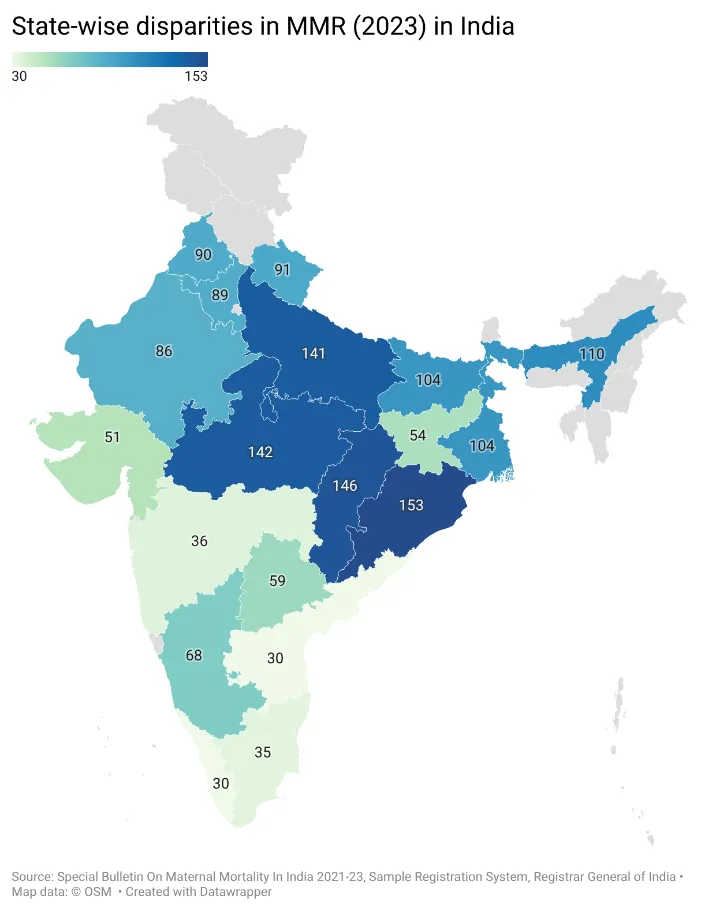
Even though India has MMR of 80 per 100,000 live births, considered on-track to achieve Sustainable Development Goals (SDG), there are wide state-wise disparities among these indices (Figure). With states like Kerala, Andhra Pradesh, Tamil Nadu and Maharashtra, already having achieved SDG targets (<70 MMR per 100,000 live births), states like Uttar Pradesh, Madhya Pradesh, Chhattisgarh and Odisha are still having MMR between 140-150 per 100,000 live births, concentrated in rural and tribal areas with significant gap in maternal health care utilisation among poor and non-poor populations.

The leading causes of maternal deaths are obstetric haemorrhage, followed by hypertensive disorders and sepsis along with continued burden of indirect causes like anaemia, heart disease, and other infectious diseases. Moreover, women from lower wealth quintile face disproportionate burden of these morbidities along with greatest impact from delays across the continuum of care, which calls for equity-focussed strategies. 

Systemic Factors affecting Maternal and Neonatal Mortality

Systemic gaps including delays in seeking timely care, limited access to emergency maternal services, and inconsistent quality of service delivery remain key systemic drivers of poor maternal and newborn health outcomes. Existing diagnostic modalities for maternal morbidities are invasive, centralised and resource-dependent – making these inaccessible to pregnant women in remote areas, further exacerbated by a fragmented referral pathway.

These gaps translate into critical delays across the caregiving continuum, with serious consequences for both mother and newborn. While conditional cash transfer programmes have successfully driven institutional deliveries, the quality of obstetric care remains a significant and unresolved contributor to maternal and neonatal mortality. Even though, coverage for the prescribed 4+ visits for ANC has improved to 58%, the quality and effective coverage of ANC among women remains sub-optimal – underscoring that mere coverage does not guarantee meaningful care. 

Moreover, current pregnancy monitoring practices rely on episodic clinical checks resulting in missed early warning signs with overreliance on manually recorded data, leading to inefficiencies for timely decisions. Frontline workforce is the backbone of maternal and child health programmes; yet they are often under-trained, under-equipped, and overburdened, undermining their capacity to deliver consistent, high-quality care. Compounding these structural deficiencies, frontline workers are increasingly diverted from caregiving by growing administrative demands of data reporting, which affects the quality of care provided. Limited public health funding and entrenched reliance on conventional workflows have plateaued the effectiveness of the health system and achievement of positive health outcomes.

India’s health system has made meaningful strides in access, successfully driving demand for maternal care. However, quality dimensions including safety, timeliness, effectiveness, person-centred care, and the efficient, equitable use of resources remain a persistent challenge, unless technology and innovation is leveraged.

Innovation in Maternal and Newborn Health Care

Technology and innovation have become an increasingly visible part of maternal health programmes in low and low-middle income countries. In India, this shift has taken place around broader efforts to expand antenatal care, improve institutional deliveries and strengthen frontline health workforce with specific use-cases for digital health platforms. Timely management of maternal and foetal complications across all stages of pregnancy can be significantly strengthened through Point-of-Care (PoC) diagnostics for early screening and diagnosis of maternal morbidities, and AI-based digital solutions that enable continuous monitoring of maternal and foetal vital parameters – facilitating risk prediction, prompt escalation and timely referral.

Despite the advent of PoC screening tools for anaemia, infections, miniaturised AI-based devices for pregnancy monitoring and mHealth tools to register pregnancies, track ANC and follow up with beneficiaries, its adoption in routine public health system remain largely limited. While these technologies have demonstrated evidence of improving service coverage, their impact on health outcomes is contingent on the strength of its integration in care continuum and broader delivery systems. These solutions operate in silos, with low interoperability with public health data systems and complex interfaces that affect usability among frontline workers. Moreover, a growing number of indigenous, non-invasive technologies are emerging that directly address the limitations of current gold standard diagnostic approaches, offering more accessible and affordable alternatives for low-resource settings. As a result, availability of frontier technologies does not always translate into better health outcomes for the population. Therefore, there is a critical need to bridge the evidence to adoption gap for science-based innovations in maternal and neonatal health by accelerating market-entry of novel innovations and embedding innovations into service delivery models, supply chains and clinical practice.

Sustained investment in a more system-aligned approach to innovation is essential to translating access gains into genuinely improved maternal and neonatal health outcomes by building a health system that is not merely accessible, but truly high-quality. 

Catalytic Role of Philanthropy in Maternal and Newborn Health

With 21% decline in global development assistance for health and further forecasted decline in the coming years, regional and domestic philanthropies should position themselves as levers to mobilize private or multilateral finance and support capacity building in civil society and local institutions to sustain and accelerate the hard-won health gains achieved over the last decades. India’s innovation ecosystem, with its growing base of health technology start-ups, strong manufacturing capacity, and government-led digital health infrastructure, offers fertile ground for philanthropy to co-invest in affordable, context-appropriate maternal and child health solutions.

Philanthropic actors are uniquely positioned to provide catalytic, patient capital by reducing investment risk for early-to-mid-stage health innovations and supporting the initial deployment of proven solutions in the underserved communities that commercial markets often overlook and government entities cannot undertake. The Bill & Melinda Gates Foundation’s 2023 Goalkeepers Report reinforced this urgency, highlighting that scaling up access to proven innovations and practices such as AI-enabled portable diagnostic devices that strengthen frontline workers’ ability to detect and manage high-risk pregnancies, and interventions that reduce postpartum haemorrhage could save 2 million additional maternal and newborn lives by 2030, if adequately and purposefully funded. Hence, philanthropy has evolved from a gap-filler to a genuine systems-builder, actively funding innovation and their integration within public health system. India’s maternal and newborn health landscape presents a compelling case for catalytic philanthropic investment, particularly in high-burden states where access to innovation-led quality care is severely constrained.

India stands at a pivotal moment in its maternal and newborn health journey where progress in access must now be complemented by high-quality care. The path forward demands more than incremental change; it calls for bold, system-aligned innovation that is deeply embedded in care delivery and responsive to the realities of the underserved populations. India can transform its health system into one that not only saves lives but ensures that every mother and child thrives. The opportunity is not just to meet MCH targets, but to redefine what sustainably financed, equitable, high-quality, innovation-led maternal and child healthcare looks like for the country.  

Conclusion:

Samyak is a health initiative housed within Collective Good Foundation (CGF), committed to improving the quality of life of India’s urban citizens by bridging existing health inequities. Samyak – CGF is a knowledge partner to the Government of Uttar Pradesh (GoUP), providing support to improve health and nutrition outcomes in 100 small, transitioning cities through the UP Aspirational Cities Program (UP-ACP). UP – ACP is a flagship program of the GoUP that aims to improve municipal service delivery, create economic opportunities and improve the quality of life of all citizens. The program identifies social infrastructure (health and education) as a key pillar for urban transformation, indicating GoUP’s commitment to improve urban health outcomes and recognition of the potential role of ULBs in this process.

The study was conducted to understand and examine the health status and challenges in these cities. The findings from the study have been shared with the Urban Development Department, Government of UP, the anchor for the UP–ACP program. Samyak is currently working with the Government (including the state health department) and other development partners in UP to collectively address these challenges through a system-led approach.

Authors:

Dr. Aatmika Nair, Manager, Portfolio, India Health Fund

Samrudhi Khanna, Sr. Associate, Portfolio, India Health Fund

Devanshi Patel, Manager, Strategy, Partnerships and Impact

Publication Date: 15th April, 2026