
Beyond AI: Building the Human Infrastructure for Climate and Health
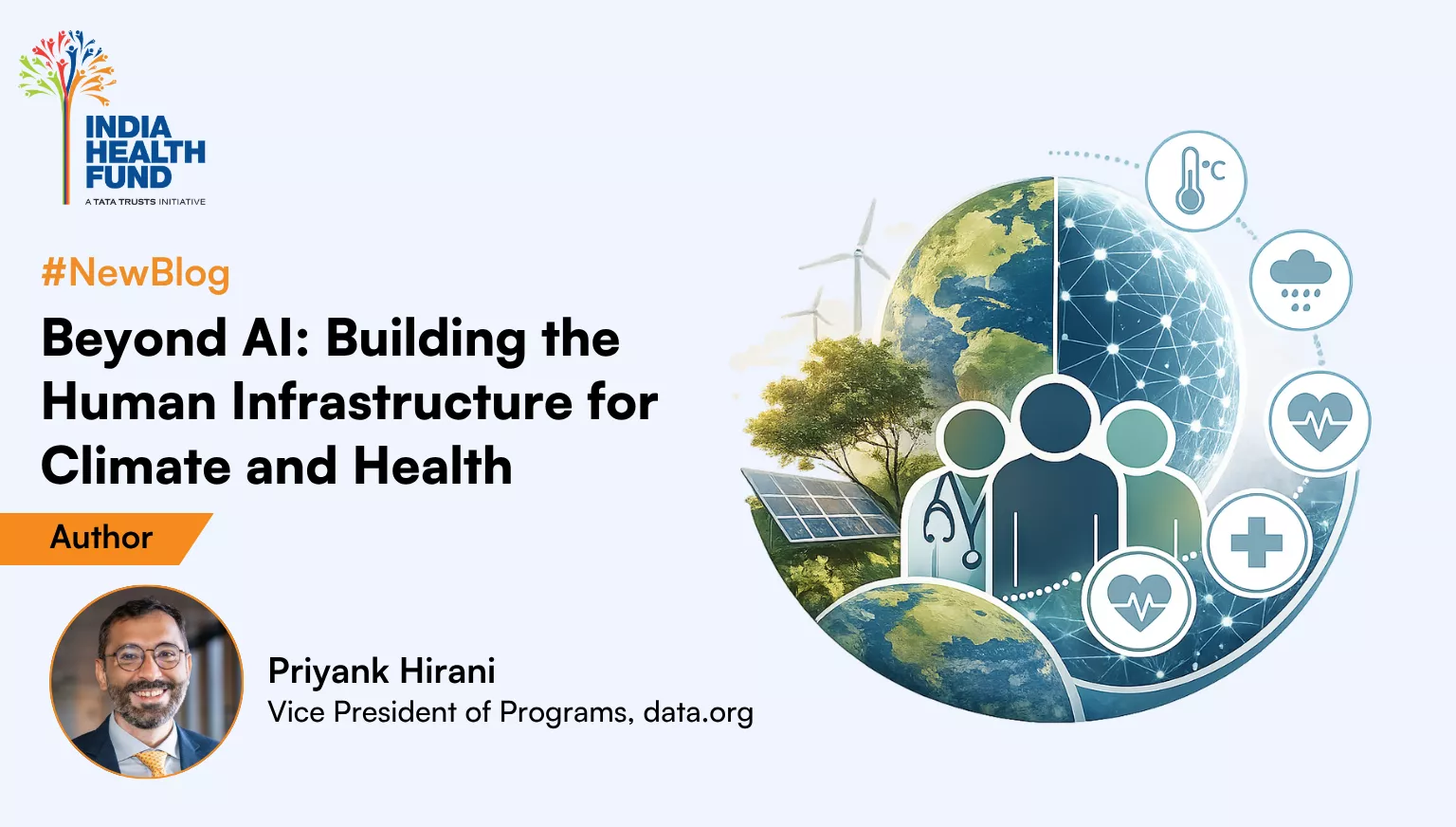
Why the next breakthrough in climate and public health won't come from better algorithms-but from the people who translate data and AI into decisions.
Priyank Hirani, Vice President of Programs, data.org
Every heatwave, flood, and disease outbreak reinforces the same reality: climate and health are no longer separate challenges. Extreme heat is increasing mortality and worsening maternal and child health outcomes. Changing rainfall patterns are expanding the spread of vector-borne diseases. Air pollution is driving respiratory illness. These interconnected risks demand equally connected solutions.
Today, advances in data and AI make it possible to forecast outbreaks, identify vulnerable populations, and support faster, more targeted public health responses. Yet, during my fifteen years of working with researchers, practitioners, governments, universities, philanthropy and civil society globally, one lesson has become clear to me.
The biggest barrier to scaling AI for climate and health is not access to technology or data. It is the structural gap between scientific knowledge and institutional decision-making. While institutions may generate vast amounts of data, they often lack the applied AI and data capacity needed to transform it into operational tools, predictive models, and policy decisions.
We need a new cadre of data-to-decision translators: professionals who operate at the intersection of science, technology, and policy, turning advances in AI and data science into better public decisions. They do not replace researchers or policymakers. They connect them, translating scientific advances into institutional capability leading to better outcomes for millions of people. I share five lessons on intentionally building this kind of data and AI workforce for Climate and Health at scale.
1. Train around real problems-not technical skills alone
People learn AI fastest when solving problems that matter.
Through data.org’s Capacity Accelerator Network, trained data and AI fellows deployed at Khushi Baby helped develop one of India’s first Climate Health Vulnerability Indexes (CHVI), integrating climate, health, socioeconomic, and geospatial datasets to identify communities most vulnerable to climate-sensitive diseases. Working alongside state governments meant the objective wasn’t simply producing a sophisticated analytical model. It was ensuring that the evidence informed planning, resource allocation, and public health action. Over 85,000 health workers and district officials tracking 60 million people’s health across Rajasthan, Maharashtra, and Karnataka have been empowered through this tool to identify hotspots for targeted interventions.
This experience reinforced an important lesson: technical capability develops most effectively when applied to real and immediate implementation challenges rather than isolated classroom exercises.
2. Data creates value when it shapes decisions
Asking the right questions is a critical step in what data is collected, how it is used and by whom.
Working with Artha Global in a first-of-its-kind study, interdisciplinary teams combined satellite imagery, neighborhood-level climate data, administrative data, and household rapid citizen surveys to understand how different communities experience heat differently across Delhi based on their locality. The study revealed, for example, that a 3°C increase in experienced heat was associated with a 15% increase in reported heat-related illness. Evidence such as this helped shift the conversation from city-wide averages towards neighborhood-level vulnerability, green cover and architecture-giving policymakers a clearer vantage point for targeting hyperlocal heat adaptation investments based on experienced heat.
The lesson is simple: In the health sector, success should not just be measured by the sophistication of data analytics, but also by whether they improve public decisions.
3. Capacity must live inside institutions
External experts can solve today’s problem. Embedded experts build tomorrow’s system.
Perhaps the strongest example comes from Epiverse, a multi-stakeholder outbreak analytics capacity building program, powered by data.org, that upskills and supports public health professionals embedded as data and AI fellows within Ministries of Health across ten African countries. Rather than acting as external consultants, fellows strengthen disease surveillance systems, establish communities of practice, and integrate open-source epidemiological analytics into routine workflows.
In Tanzania, institutionalizing data analytics capabilities across the public health ecosystem through a data and AI fellow helped contain a 2026 cholera outbreak four times faster than before. In Rwanda, a data and AI fellow helped reduce surveillance reporting and forecasting time for emerging infectious diseases (EIDs) by more than 85%, demonstrating that sustainable capacity is built by strengthening institutions-not simply transferring knowledge.
The most enduring output is not new software. It is a Ministry of Health that can continuously transform disease surveillance data into operational intelligence.
4. Ecosystems outperform individual organizations
No single institution possesses everything needed to solve climate-health challenges.
One of the clearest lessons from engaging with 100+ partners, 500+ learners and 60+ fellows across the Africa and India Capacity Accelerator Network hubs over the last four years was that progress accelerated when universities, governments, civil society organizations and private-sector partners learned together rather than separately, building on each other’s work and sharing knowledge and insights instead of working in siloes. This proved especially true in an emerging, interdisciplinary field such as climate and health.
Across different geographies, the program invested not only in technical training but also in organizational data maturity, communities of practice, and cross-sector collaboration across diverse experts. Participants consistently reported that peer learning, trusted partnerships, and shared problem-solving were as valuable as the technical curriculum itself.
Climate-health innovation scales through intentional ecosystems-not isolated excellence.
5. AI succeeds only when people trust and use it
Technology adoption is fundamentally a human challenge.
Through data.org’s partnership with CivicDataLab, a data and AI fellow helped develop the Intelligent Data Solution for Disaster Risk Reduction (IDS-DRR), an AI-enabled platform integrating 38 datasets to identify flood vulnerability and support disaster planning.
But technology was only half the story. The program also trained more than 250 government officials to interpret, apply, and institutionalize these insights within disaster management planning.
The key takeaway: the platform created a new capability. The people ensured it became part of everyday decision-making.
Building the AI workforce that the Climate and Health Ecosystem needs
India has an extraordinary opportunity to become a global leader in climate and health innovation. It has world-class digital public infrastructure, rapidly growing AI capability, and an increasingly vibrant innovation ecosystem.
The next frontier, however, is not just building more AI. It is also building the workforce that enables public institutions to absorb advances in science and translate them into action.
Governments should create interdisciplinary AI and data roles within climate and health ministries. Universities should integrate public health, climate science, AI, and public policy into shared curricula. Funders should invest not only in promising technologies, but also in the people and institutions that enable those technologies to scale.
If the past decade was about building digital infrastructure, the next decade must be about building human infrastructure to leverage AI for impact.
Every breakthrough in AI, epidemiology, or climate science creates new possibilities. But those possibilities are realized only when someone inside an institution has the capability to translate scientific advances into policy, programs, and operational decisions.
The future of climate and public health will not be determined solely by better algorithms. It will be determined by our ability to close the gap between scientific discovery and public action. That is the work of the next generation of data-to-decision translators.
References / Additional Reading:
- https://data.org/playbooks/lessons-from-indias-data-capacity-accelerator-for-climate-and-health/c/fellowships-in-action/flood-risk-analysis-platform-for-effective-disaster-planning/
- https://data.org/stories/khushi-baby/
- https://data.org/news/bridging-regions-building-capacity/
- https://data.org/reports/mapping-heat-inequality-across-neighbourhoods-in-delhi/
- https://data.org/playbooks/africa-can/
Author:

Priyank Hirani
Vice President of Programs, Data.Org
Priyank Hirani
Vice President of Programs, data.org
Publication Date: 27th July 2026