
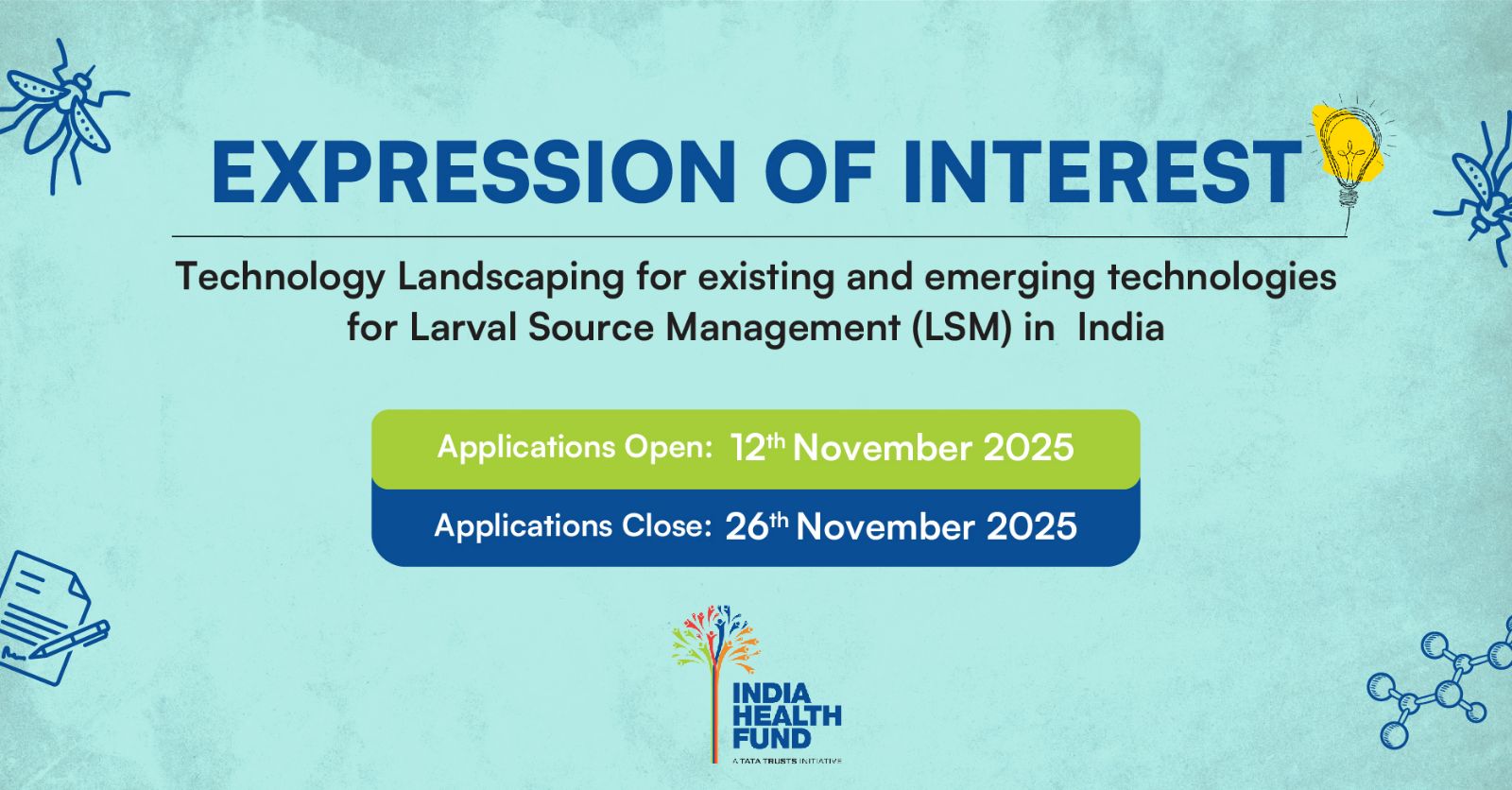
Deadline to submit the Expression of Interest has been extended to 7 December, 2025
Background
Vector Borne Diseases (e.g. dengue, chikungunya, malaria, zika etc.) remain a significant public health challenge in India, placing millions at risk, particularly in rural, peri-urban, and rapidly urbanizing areas (PMC, 2023). Despite notable progress in reducing incidence and preventing outbreak of these diseases, the country’s goal of elimination is threatened by persistent and evolving mosquito breeding behaviours (Mechan et al., 2023).
Larval Source Management (LSM), which targets the aquatic stages of mosquitoes, is a proven strategy for reducing vector populations before they reach adulthood (Med J Malaysia, 2015) and become infectious. However, large-scale application of LSM in India faces significant operational challenges, including the identification and management of diverse and often hidden breeding sites (PMC, 2023). India’s rapid urbanization and unplanned development have resulted in a proliferation of both natural and artificial mosquito breeding habitats, ranging from stagnant water in construction sites and discarded containers to poorly maintained drainage systems and overhead tanks (Mechan et al., 2023). The sheer number and diversity of these sites make manual identification and treatment labour-intensive and often incomplete (MDPI, 2022).
Effective LSM relies on detailed knowledge of local vector species, their breeding preferences, and seasonal dynamics. A deep understanding of mosquito breeding behaviour is fundamental to the success of vector borne disease control and elimination efforts. Such knowledge enables precise targeting of LSM interventions, maximizes resource efficiency, and allows for adaptation as vectors change their breeding habits (MDPI, 2022). Additionally, urbanization and climate change are continually altering mosquito breeding patterns, making ongoing surveillance and behavioural studies essential for proactive and adaptive vector control and management. To complement this knowledge-driven approach, the integration of technology and innovative solutions becomes crucial, as they enhance surveillance accuracy, enable real time decision-making, and support scalable, cost-effective implementation of LSM interventions. Thus, landscaping of technologies is critical in defining technology gaps as well as selecting key technologies to initiate and develop collaborations, with the ultimate goal of providing transformative tech enabled LSM solutions.
Scope of Work and Activities
The objective of this EOI is to identify new partners that can support India Health Fund in building a comprehensive technology landscape to guide future engagement in technology enabled LSM for vector-borne disease control in India. This landscaping exercise will not only map the current state of technology but will also generate actionable evidence, provide comparative analysis, and offer clear recommendations to guide the integration of suitable technologies into India’s vector control programs and inform future programmatic and policy engagement.
Technology Landscaping Activity
The technology landscaping activity will use a mixed-method approach to develop a comprehensive overview of existing and emerging products and technologies for LSM in India. It will assess the following:
- State of readiness of technology-enabled solutions and provide a comparative analysis of their efficiency, cost, scalability, and potential impact.
- Applicability across diverse geographies—urban, peri-urban, and rural—highlighting contexts where these solutions are most feasible and cost-effective, as well as identifying situations where LSM may not be the optimal strategy.
- Barriers to adoption and scale-up, including regulatory, financial, and operational challenges; identify capacity-building requirements for successful uptake; and document use cases and opportunities for integrating multiple technologies.
- Potential pathways for scale & integration in vector surveillance programmes in India (city, block, district, state, national) for prioritized solutions / technologies
- Funding requirements for integration in vector surveillance programmes in India & the role of philanthropic funding (at what points is this needed, kinds of funding & duration)
- Identify opportunities for private funding in LSM and identify mechanisms to make technology solutions investible
Detailed scope/areas for technology landscaping are provided below:
- Detection and Mapping– For instance, technologies/innovations that identify mosquito breeding sites, map hotspots, predict seasonal breeding patterns etc.
- Intervention and Control– For instance, targeted application of larvicides, biological control agents, or other interventions at identified breeding sites etc.
- Monitoring and Surveillance– Continuous monitoring of larval habitats, real-time tracking of intervention effectiveness, early warning for changes in vector behaviour etc.
- Integration and Cross-Sectoral Applications– Shared data platforms across sectors; leveraging agricultural drone networks for public health interventions etc.
This study is expected to be completed within a period of around 4 months. We have provided an indicative list of deliverables to consider.be completed
Deliverables (Indicative):
| Sr. No | Description |
|---|---|
| 1 | Methodology, scope, detailed framework for assessing technology readiness and integration pathways. |
| 2 | Roles, responsibilities, engagement pathways across government, research, private sector, NGOs |
| 3 | Field survey/site visit summary report with insights from urban, peri-urban, and rural contexts |
| 4 | Tech Landscape: covering detection, intervention, monitoring, integration; readiness, cost-effectiveness, scalability Comparitive Analysis: of barriers, enablers, and use cases for tech-enabled LSM (India + global learnings) |
| 5 | Validation workshop with experts and stakeholders; consolidated feedback note |
| 6 | Final comprehensive report with actionable recommendations and pathways for future investments (including contexts where LSM may not be relevant) |
| 7 | Summarizing findings for IHF, and government partners |
Consultant / Agency eligibility criteria:
- Demonstrated experience in conducting comprehensive landscaping studies, market research (quantitative and qualitative), or policy analysis in the public health sector in India
- Strong expertise in technology assessment, particularly concerning drones, GIS, remote sensing, and AI/ML applications.
- Good understanding of vector-borne diseases and public health programs in India.
- Experience in engaging with government stakeholders in India (central, state, district level) and understanding the dynamics to generate meaningful insights.
- Strong team members with relevant backgrounds (e.g., public health, environmental science, technology/engineering, policy research and data analysis)
- Demonstrated experience in scoping funding opportunities for technology solutions from the private sector
- Either be a proprietor or partnership firm, company, or any other institution registered in India
Other eligibility criteria (Disqualification):
- Applicants should not be insolvent, in receivership, bankrupt or being wound up, not having its affairs administered by a court or a judicial officer, not have their business activities suspended, and must not be subject of legal proceedings for any of the foregoing reasons.
- Applicants and their directors, partners, proprietors, and officers should not have been convicted of any criminal offense related to their professional conduct or the making of false statements or misrepresentations as to their qualifications to enter into a procurement contract within a period of three years preceding the date of this EOI.
- Applicants shall not be in frequent litigations. A list of litigations in the last 7 years shall be provided along with the Application.
- Applicant should not have been blacklisted or debarred or de-registered or otherwise disqualified pursuant to any debarment proceedings, by any Central or State Government, Local Government or Public Sector Undertaking or private sector in India and which is for the time being in force. Applicants should not have any interest in such debarred or blacklisted or deregistered/ banned firms.
- Conflict of Interest among Applicants: The Applicant found to have a conflict of interest with other Applicant(s) shall be disqualified. The Applicant shall be considered to have a conflict of interest with one or more Applicants in this EOI process If:
- they have a common owner having not less than 20% interest in both the Applicant
- they have the same legal representatives/agent for purpose of this EOI, or
- they have a relationship with each other directly or through common third parties, that’s put them in a position to have access to information about or influence on the bid of another Applicant,
- more than one application from a single Applicant in this EOI process.
Duration of the Project:
The assignment is expected to be completed in not more than 4 months from the date of contract signing.
EVALUATION CRITERIA
| Criterion | Weightage |
|---|---|
| Relevance and Understanding of Scope (Vector Surveillance management & Control) | 25% |
| Methodology and Technical Approach | 30% |
| Expertise and Experience in technology landscaping and health innovations | 25% |
| Cost-effectiveness and Resource Utilization | 20% |
Timeline
| Date | Activity |
|---|---|
| 12th November, 25 | Release of EOI |
| 26th November, 25 | Deadline for submission of proposals |
| 13th December, 25 | Screening & Evaluations of proposals |
| 21st December, 25 | Final selection and notification email to applicants |
Note: The above timelines are indicative, and the Client reserves the right to change the timelines at its own discretion.
How to Apply
Prepare your proposal by filling out this Excel form and attaching the portfolio of past work on technology landscaping of health innovations that you can send to this address: pitch@indiahealthfund.org
Please include “Technology Landscaping for LSM in India – Proposal and Portfolio” in the subject line when submitting your proposal.
ABOUT INDIA HEALTH FUND
India Health Fund (IHF), incorporated as Confluence for Health Action and Transformation Foundation (under Section 8 of Companies Act, 2013), was seeded in 2017 by Tata Trusts and with strategic support from The Global Fund. IHF was conceived to accelerate India’s progress towards the elimination of infectious diseases. IHF does this by addressing the gaps in funding for product development, in mentorship and in market access that are often faced by small and mid-size entities with powerful ideas that have the potential to significantly improve outcomes in the prevention, diagnosis, and treatment of infectious diseases. IHF also works to develop effective business models, implementation partnerships and financing mechanisms which help to significantly scale up these solutions – enabling impact at scale.