
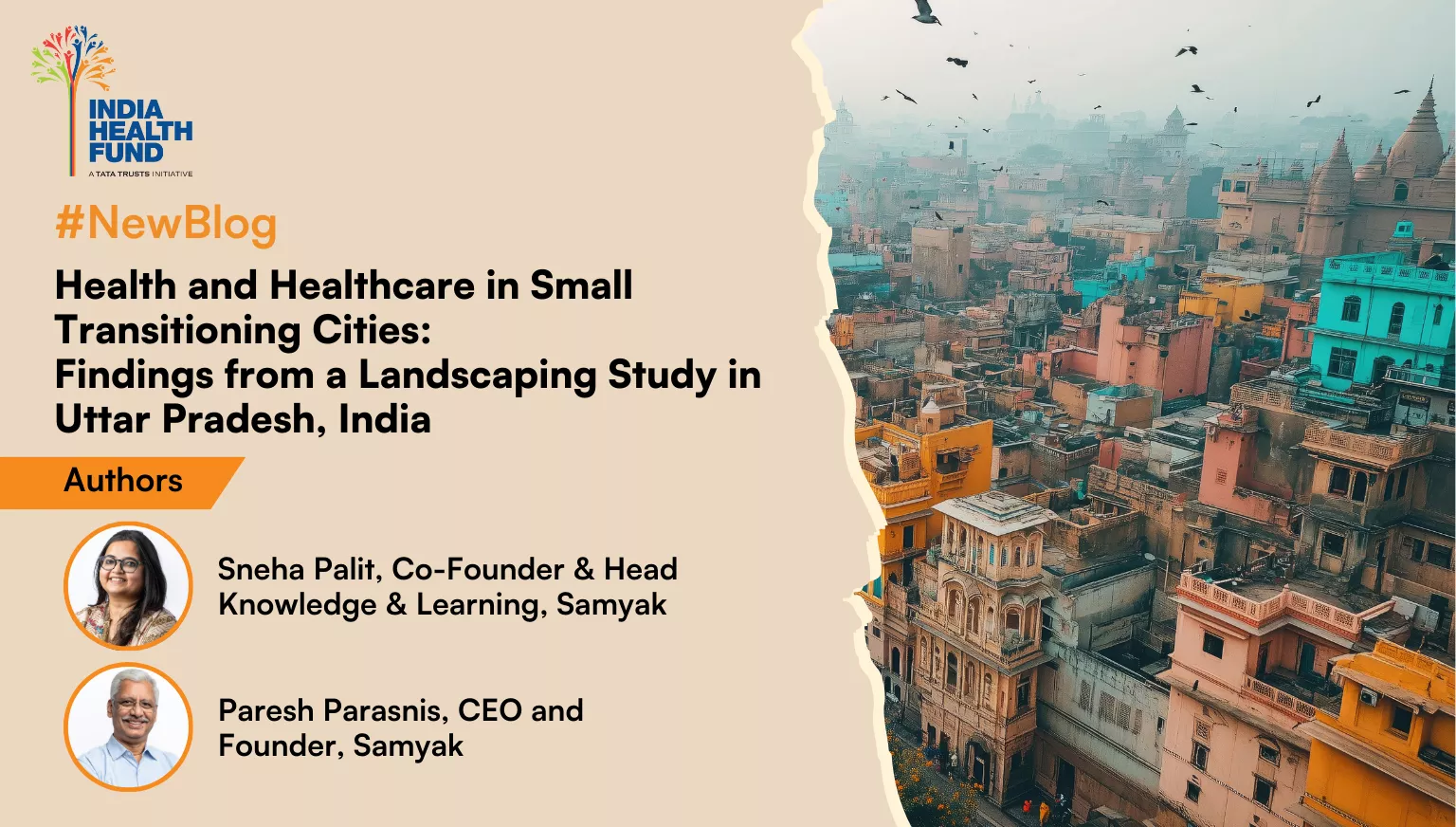
Health and Healthcare in Small Transitioning Cities: Findings from a Landscaping Study in Uttar Pradesh, India
Understanding health and healthcare in small, transitioning cities in UP
- health needs and perspectives of communities (especially urban poor and vulnerable communities) on health and healthcare.
- institutional mechanisms and processes shaping governance and service delivery,
- convergence of local government agencies in the delivery of public health services.
Barriers to accessing healthcare services
Common diseases and challenges
In addition to the challenges faced by the poor and marginalised in accessing maternal and child health services through the government system; prevalence of flu, fever, typhoid, malaria and dengue were cited as the most commonly occurring diseases across all cities. While seasonal, these were stated to be extremely frequent. The awareness and perceived prevalence of non-communicable diseases such as varied across locations, with people in areas with a relatively higher degree of urbanization being more aware of them, and perceiving them to be highly prevalent.
For example, Renukoot is relatively more urbanised compared to the other four cities, with industrial establishments and in-migration from neighbouring areas. During discussions in Renukoot, community members were aware of diabetes and hypertension, stated how the prevalence of Tuberculosis as a commonly occurring phenomenon among factory workers and labourers, could link sanitation and waste to health, as well as highlighted climate change related issues. .
Health governance and healthcare delivery
The cities selected for this study had a total population ranging from 24,000 – 32,000. On aspects of health governance, we found that these cities continue to be governed as per rural healthcare norms, instead of urban healthcare norms. In India, the National Urban Health Mission (NUHM) is implemented in cities with a population of 50,000 and above; while all cities and towns below 50,000 populations are governed as per National Rural Health Mission (NRHM). There is currently no guideline or framework in place to guide the transition of health facilities and healthcare delivery, or build the capacities of the health workforce, as spaces transition from rural to urban.
The impact of this gap is felt especially on service delivery and outreach work by frontline health workers, who remain untrained on dealing with changing socio-cultural and economic compositions, shifting healthcare needs of the people and evolving epidemiological transitions generally associated with rapid urbanization.
A related finding was with respect to health data systems, critical to measure population-level health outcomes. Interestingly, we found that the health system does not maintain city-level health data or service delivery information. Presently, the health Management Information Systems (MIS) maintains health facility-level data, consolidated at the block and thereafter, at state and national levels. Therefore, information on the health status of people living inside the city is not available. This directly impedes health planning, prioritization of services and targeted service delivery.
Convergence for public health within the city
Although public health is listed as a ULB function in the 12th Schedule to the Constitution pursuant to the 74th Constitutional Amendment Act; Uttar Pradesh, similar to most states, has not effected functional, financial, or administrative devolution of core public health functions to ULBs. ULB roles are largely confined to environmental health functions (sanitation, waste management, vector control, licensing) rather than core public health planning, staffing, or financing.
Currently, Nagar Panchayats are mostly involved in ad-hoc public health-related activities such as fogging and spraying of insecticides, identifying land and buildings for the establishment of health infrastructures, and periodic coordination for national health campaigns. However, they lack a prominent role in healthcare planning or delivery.
Surprisingly, we found no institutionalised platforms for inter-departmental engagement or coordination between the ULB and the health department. Officials rarely come together to discuss city health needs, create joint action plans or review health service delivery within the city.
Recommendations
Any solution that we visualise for addressing health issues of the urban poor, at population scale, needs to start by situating small, transitioning cities within the broader discourse on urbanization and local governance. The approach of Samyak [13] and the Urban Health Initiative, underscores the need to strengthen health systems, inter-sectoral coordination, and institutional capacities.
1. Addressing rural – urban policy and programmatic gaps: It is essential to expand the scope of NUHM to cover cities with population less than 50,000. The same has been recommended in the (draft) NUHM 2.0 guidelines [14]. In the meantime, clear guidelines are needed for transitioning cities, highlighting changes in health governance and service delivery mechanisms for these cities. Subsequently, the health workforce needs to be trained on addressing health challenges linked to urbanization, and data systems need to be streamlined to measure city health status.
2. Reimagining service delivery models: Extending rural healthcare service delivery models to urban contexts may not be the best way forward. As cities evolve, we need to reimagine service delivery models and leverage technology-based and AI enabled tools to address current healthcare delivery gaps for screening, diagnosis and community-based surveillance.
3. Strengthening institutional mechanisms: Capacities of the Nagar Panchayats (NPs) need to be strengthened on aspects related to integrated planning, financial management and budgeting, inter-departmental coordination, implementation and monitoring. While not directly engaged in healthcare delivery, NPs play a critical role in addressing social and environmental determinants of health. Therefore, they need to be equipped with knowledge, skills, resources and tools to address city needs and challenges.
4. Integrated planning for the city: Place-based plans that address hyperlocal problems, that are co-created by different departments, and incorporate citizen needs and voices, are essential to improve health outcomes and the overall quality of life. The small size of these cities provide an opportunity to experiment and innovate, through the development of inter-sectoral plans for the city as a unit. While this is a shift away from mainstream planning processes practiced by the government (which are sector/department focussed), integrated City Action Plans (iCAP) can lead to transformational change in these cities. In UP, we have worked closely with the Urban Development Department to embed this idea within the ambit of the UP Aspirational Cities Program; and are currently facilitating the development of iCAP for 100 aspirational cities.
5. Inter-departmental coordination and convergence: Spaces for inter-departmental coordination are essential to improve overall governance measures. Whether through the formation of an inter-departmental committee, or to oversee the creation and implementation of City Action Plans, platforms where officials can convene, share updates, discuss challenges, co-create plans and monitor outputs need to be established and strengthened. This would allow for coordinated actions, enhanced fund allocation and utilization across departments and better outcomes across sectors – eventually leading to improved quality of life of citizens.
6. Forums for community action for health: To bridge current gaps and enhance trust between the government and citizens, community forums need to be established. For UP, ward committees are mandated for cities with a population of 300,000. This needs to change and ward-level committees need to be established. These committees can become centres of participatory action with hyperlocal planning, multi-sectoral action and community-led monitoring of service delivery. Activities such as vulnerability assessments, health needs assessments, ward-level integrated health planning etc. could be undertaken by these committees.
Conclusion:
Samyak is a health initiative housed within Collective Good Foundation (CGF), committed to improving the quality of life of India’s urban citizens by bridging existing health inequities. Samyak – CGF is a knowledge partner to the Government of Uttar Pradesh (GoUP), providing support to improve health and nutrition outcomes in 100 small, transitioning cities through the UP Aspirational Cities Program (UP-ACP). UP – ACP is a flagship program of the GoUP that aims to improve municipal service delivery, create economic opportunities and improve the quality of life of all citizens. The program identifies social infrastructure (health and education) as a key pillar for urban transformation, indicating GoUP’s commitment to improve urban health outcomes and recognition of the potential role of ULBs in this process.
The study was conducted to understand and examine the health status and challenges in these cities. The findings from the study have been shared with the Urban Development Department, Government of UP, the anchor for the UP–ACP program. Samyak is currently working with the Government (including the state health department) and other development partners in UP to collectively address these challenges through a system-led approach.
Authors:

Sneha Palit, Co-Founder and Head: Knowledge & Learning, Samyak
Paresh S Parasnis, Founder and CEO, Samyak